An especially warm welcome back for all those who have stuck through the previous two parts of this post series on strength training! All those who haven’t, I’d firstly advise you please do, but do also stress that there’s still plenty to be going on with right here alone.
The Strength Training – Why, What and What Next to Achieve Your Goals three part series has presented an introduction to this in-depth subject.
The first post looked at why everyone should incorporate some sort of strength training and the second explored some basic functional bodyweight exercises to increase strength and mobility for both the lower body and the back.
This final post in the series will detail push exercises to incorporate for the shoulders, chest and arms. I’m purposely not getting too specific on these posts on referencing hitting the triceps (backs of arms) or isolating the upper or lower pectoral muscles (chest),as in my opinion at least, a multi movement approach is generally best for the goal of functional strength. This was covered in the first post of the series where we discussed the three planes of motion the body can travel through; the sagittal, frontal and transverse planes.
The final part of this post will present an approach to weight lifting that I believe can represent a significant progression for athletic performance. This is not heavy weight training for big chiselled muscles, rather a method that will build both relative and absolute strength as well as strength endurance, which we’ll detail also.
Push & Push exercises
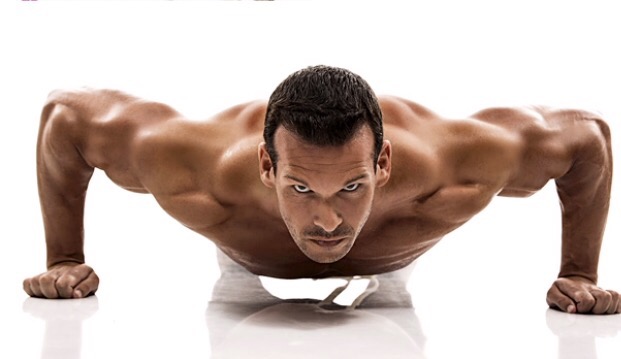
The humble press-up, forever associated with the marines, or the P.E. school teacher who thought his or her role was to train you for said marines. There is however a ton of variety and tweaking that can be done to make the entry level exercise a serious strength developer.
Press-up
Ok, I’m not going to reinvent the wheel with this one but I am going to give a few tips to make this a more challenging exercise whilst bringing greater strength rewards and ultimately getting more from less.
The vary basics are your initial position. Hips and bum should not be higher than your shoulders, arms (initially) should be just wider than shoulder width and your head up to form a perfectly straight line down the body.
I now want you to cast your mind back to the first post where I detailed the squat. In this post I discussed feeling like you have coiled springs in your legs. This transfers to the arms now. Push down into the floor and tense both arms as you go down and back up. This is especially effective if you do the press-ups on your fists.
Doing press-ups on the fists will have a number of benefits including removing pressure from the wrists and serving to strengthen them. It will also mean you need to stabilise your whole body more, serving to work the core more intensely. Try moving the positions of your fists between horizontal to work the chest and shoulders and fists parallel to the body to hit the back of the arms (triceps).
Lastly, place one foot on top of the other, this will simply intensify the load and again require you stabilise more.
The Spiral Clock
So I could real off a very very long list of various hand positions to hit different parts of your upper body and arms. However, I’m going to ask a little of your creative minds and to stick with me as I present this metaphor; the spiralled clock.
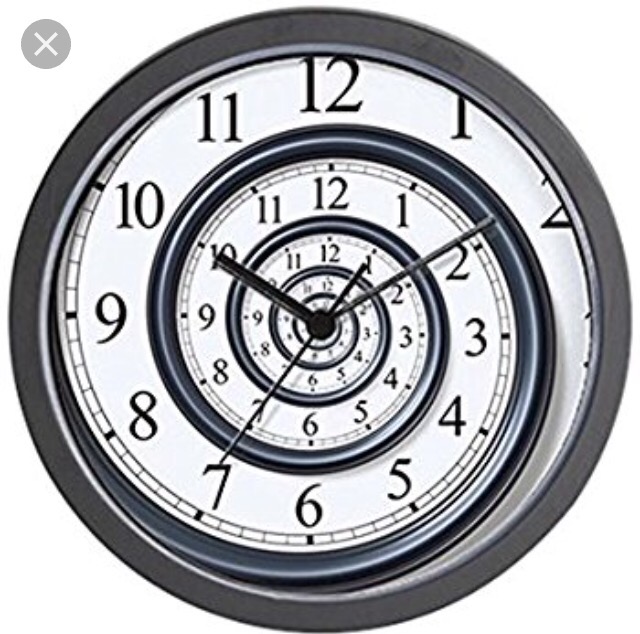
Essentially imagine a spiral coming out from the centre of your chest that continues to as wide as you can reach. Around the edge are the clock you have your numbers. Quite simply your imagination is the only block here when completing press-ups.
These multiple variations can hit a variety of different areas in your upper body, predominantly being chest, shoulders and arms. For example, try 12/3 middle spiral, 10/2 inner spiral and 9/3 outer spiral. The more you work varied numbers and depths, the better the overall gains.
Want to mix it up further (he asks metaphorically)? Try raising your feet or hands. Or even both!
Half moon press up
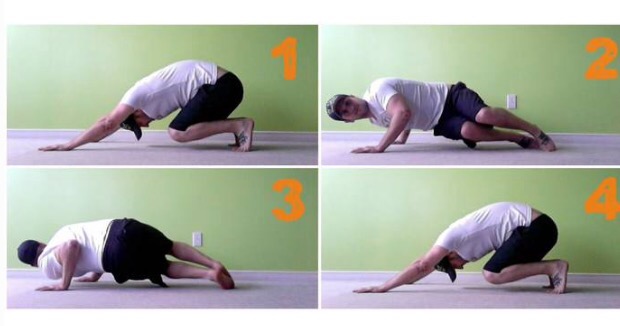
I wanted to include this exercise due to its rotational element. As discussed previously the body moves through 3 predominant ranges of motion hence the importance of rotational strength training. This exercise will hit all three planes and translates very well for functional upper body strength.
Start in a bear squat position with your arms fully outstretched, hands shoulder width apart, feet hip width apart, and your knees bent with your bum close to your heels.
Keeping your body low to the ground, pull yourself through your hands in a pull up motion. At the same time turn your knees and torso out toward the left. This should put more weight onto your right hand. Once your chest is in line with your shoulders and palms, begin to shift little more weight to the left hand and turn your knees and torso out to the right side.
Once you are fully facing the right side, begin to push yourself backward and turn your torso/knees back to the starting bear squat position. Alternate the side you turn toward while initiating the push up each time. For example, we turned to the left to start the rep described above, so we would perform the next rep by turning to the right.

This push up should be performed in one smooth and seamless motion as if your chest is tracing a semi circle across the floor, and as such, a half moon. This is quite a tough exercise so I’d advise focusing more on a slow and deliberate movement to get the greatest benefit from the full range of movement. So when thinking about reps and sets, keep the rep count low of each set initially.
Russian Press-ups
This is a challenging exercise that will especially strengthen the triceps at the back of your arms whilst also building the shoulders and forcing you to stabilise your midsection.
I like to think of this exercise in 4 sections. Get into the standard press up position to begin. Part 1 is dropping into half press up position so your upper and lower arm have a 90 degree angle between them. Part 2. Shift backwards so your forearms are flat on the floor, parallel to your body. For part 3, push back off your forearms into half press-up position again. Part 4 is of course pushing up to start again. Try to complete the exercise in one flowing motion.
Twisting Press-up
The twisting press-up will work the rotational muscles in your core, and improves flexibility in both your hip and groin muscles. It’s also a slightly easier exercise than the half moon press-up.
Assume the standard press-up position, but form fists with your hands so your knuckles are flat against the floor. Rotate your hips to the right and cross your right leg in front of your left. Then lower your chest toward the floor as you would for a standard pushup, being careful not to let your hips touch the floor. Push back up and return to the starting position. Repeat with your left leg.
The Intrinsic Strength (IST) Press-Up
Ok, last exercise. IST press-up variations deliver another rotational strength element, but this time to the upper body.
Intrinsic Strength Press-ups offer three variations to the horizontal pushing motion during the same set without having to change the position of the hands. This simple eye gaze over the right and left shoulder allows the muscles to stay engaged, providing the body with greater time under tension while still delivering a variation between between the sagittal and transverse planes (of motion).
This horizontal rotation is performed by lowering down to the bottom of the push-up while simultaneously taking the eye’s gaze over one of the shoulders. This transverse plane variation causes the shoulders, torso, and hips to rotate to that same side, changing the weight distribution through the arms.
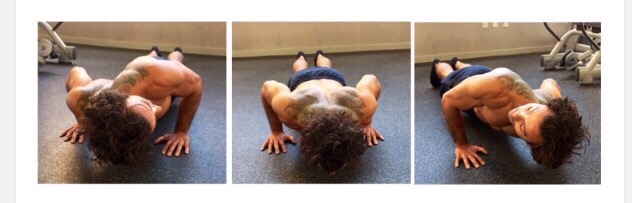
There are basically 3 press-ups to be included in 1 repetition here, this insures you distribute the strain fully over the full chest, back and arms. Start in usual press-up position, feet shoulder width apart. While lowering down to the bottom of the first push-up, simultaneously take your gaze over your right shoulder and return to the high plank position.
For the second press-up in the repetition, do a regular press-up, returning back to the high plank position on completion. While lowering down to the bottom of the third push-up, simultaneously take your gaze over your left shoulder, completing the same movement as on the first press-up. On completion, return to the high plank position.
Allow every joint to help with the full body rotation. Your eyes will direct your head, shoulders, spine, and hips to rotate towards the same focal point (above the shoulder). Actively apply pressure into the ground through your legs and feet to create lower body tension. Actively apply pressure into the ground through your shoulders and fingers to create upper body tension. When turning the head over the right shoulder, you will feel more weight and tension will shift into the left shoulder and the stretch will be felt throughout the left chest.
Strength
Alrighty, the progression for the strength training of athletes will now be detailed. Just prior to detailing exactly what MSP training is however, I just quickly want to define exactly what the strength areas that this approach will develop.
Relative strength is the amount of strength to body size, or how strong you are for your size. This reflects a person’s ability to control or move their body through space, a vital trait in athletics.
Absolute strength is the maximum amount of force exerted, regardless of muscle or body size. Greater amounts of absolute strength favor those with higher bodyweight and in general, larger individuals. Greater absolute strength will improve relative strength capabilities.
Muscular endurance is the ability of a muscle or group of muscles to sustain repeated contractions against a resistance for an extended period of time. In strength training for example, muscular endurance refers to the number of repetitions of a single exercise you can do without needing to stop and rest.
Lastly, power. Power in the athletic context is defined as the ability to exert a maximal force in as short a time as possible, as in accelerating, jumping and throwing implements. While strength is the maximal force you can apply against a load, power is proportional to the speed at which you can apply this maximal force.
Maximum Sustained Power training
Maximum sustained power, or MSP , training is an approach using loads that seeks to improve maximum power whilst improving your ability to sustain this maximum power even as you fatigue.
I first became aware of MSP training by reading the great Mark Sisson’s book ‘Primal Endurance’. MSP is a way of training that will build muscle but not purely bulk you out. As highlighted, it can also build power, strength as well as help to reduce the risk of injury.
If adapting the MSP approach, seek to use big compound exercises, (basically exercises that use more than one muscle group). Examples of such exercises are squats, deadlift, shoulder press, bench press, box jumps, weighted pull/chin and weighted dip. When choosing your weight (or height in the example of box jumps), it’s important that you choose a weight that your able to do a maximum of 5 repetitions of, anymore and you won’t get the desired outcome.
To conduct an MSP workout I’ll show you the below example. Firstly you’ll lift your new five-repetition maximum weight three or four times, then rest for ten to twenty seconds. This is critical as if you hit 30 seconds or over you’ll loose the benefits. Then you’ll do (for example) three more reps, rest 10/20 secs, do two more, rest, do two more, rest a bit, do two more, rest a bit, then perhaps only muster up one rep on your final “mini-set.” And that party people, is Maximum Sustained Power workout.
Form is also important here as you’re working with heavy weights. Strength is a skill and therefore incremental increases in weight should be used and form not sacrificed.
I like to condense the workout into 3 sets of 4 mini sets. The rest breaks between each set of 4 mini sets are critical here. You’ll need to ensure a minimum of 2 minutes in between a full set. There can sometimes be desire in athletes to reduce rest periods to increase intensity. This indeed is essential when seeking to increase purely endurance for example but will not support the development of maximal power and/or strength. MSP workouts are incredibly taxing on the Central Nervous System so allow the two minutes so you can attack the next set of mini sets with equal intensity.
I feel it is necessary to caveat this final piece regarding the enhancing of strength and power in athletic performance by noting that there are tipping points in all modalities of training. When seeking pure explosiveness for example, there a definitely different ways to train to enhance to area. Similarly, periodisation is another key element. That, however my friends, is for another day!
Well, thank you for sticking with me on this post. There’s been a lot of ground covered and I do hope you read the first two posts to get a fuller view of strength training, how and why to implement it into your lifestyle. Until next time, thanks for reading. Please comment and share the love by sharing this article.


 Nutrition 4 Fighters