Snack Hack # 20 – Ribbing’s Bike Memory Technique – 2 minute read

Welcome back to the Snack Hack series. These posts aim to bring some easy and actionable tips and tricks into your everyday life. Today’s hack is a nice, simple and memorable one. It’s a memory technique you can implement from everything from your shopping list to a meeting at work, it’s all just dependant on your creativity.

This technique is called the Ribbing’s bike and comes via memory big gun Mattias Ribbing. The idea is to picture a bike. Any bike. Make it a memorable one though. Now enlarge it in your head and imagine it as big as an SUV, standing in front of you. Think of 10 tasks you need to remember, things like picking up a file from work, dropping off your dry-cleaning, resoling your winter boots, picking up the food shopping, whatever.

Now assign an image to each thing, something vivid, with sharp lines, which Ribbing claims stick in your mind better than amorphous shapes. “For example, visualising a sun,” he said. “That’s not really good because it’s not a fixed outline.”

For each task, take the first image that comes to mind (a pair of boots, a bag of food shopping, suits on a rack, whatever), enlarge it and hold onto it. Then you’ll begin putting each object on a different part of the bike, mentally connecting the two, so something like “front tire” is synonymous with food shopping.

When you visualise a bike, you place an image on the front tire, then move slowly back to the spokes, then to the hub in the center of the wheel. The technique plays on the power of having a visual association to whatever you’re trying to remember.

Ok, hope this is something that may come in handy. In an age where we rely so heavily on our phones for information, it pays to be able to rely on our most secure and reliable piece of tech; the one in your head.

What the Experts Say – Longevity – 2 minute read

Welcome back to the What the Experts Say series. These short sharp nuggets of wisdom are bought via some of the leading lights in the health and wellness space. They’re not loaded with the research and technical knowledge that backs their presenters so please go dig deeper if you wish!

Ok, without further ado. Today’s topic is longevity. Here are 3 tip bits to how to measure and improve your health span.

First up we have Dr Kate Shanihan. Kate’s fantastic in-depth read ‘Deep Nutrition’ is a thorough exploration on the modern diet’s impact on health and well-being. She noted on the Primal Blueprint podcast that connective tissue is the biggest determining factor to quality of life as you age as it literally holds you together! Want to improve yours? Meat on the bone and bone broth.

Next up we have Dominic D’ Agostino, the keto king pin from most famously Tim Ferris’s and Joe Rogan’s podcasts. Dom stated blood glucose monitoring is the best health bio marker we have. In order to track it, test fasting and postprandial blood sugar markers. Doing this will predict how well functioning your metabolism really is.

Lastly, Mr Mike T Nelson. Mike is the man when it comes to metabolic flexibility and I’d recommend having a read of this previous post I did about his advice on a fasting with an exercise routine http://whatsuppblogblog.com/2018/12/07/dr-mike-t-nelsons-carbohydrate-cycling-exercise-plan-for-health-fitness-wellbeing/ . Mike highlights the following markers of longevity – 1. lower body strength; 2. grip strength; 3. VO2 max. So with that in mind get your squat on, fingers gripping and feet sprinting.

Alrighty, hope there was some takeaways. Please drop me a comment and a like! Till next time.

How to Prioritise – The Eisenhower Matrix – 2 minute read

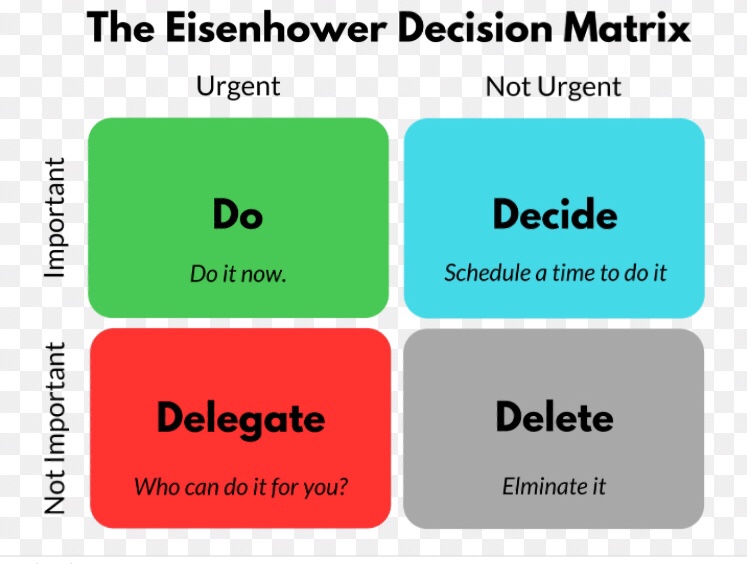
Welcome back to the What Supp Blog. Today’s post is about how to get sh*t sorted and prioritise. With this in mind, I’ll introduce you to the Eisenhower Matrix.

The Esinhower Matrix is a method used by a former American president Dwight D. Eisenhower. Eisenhower was the 34th President of the United States from 1953 until 1961. Before becoming President, he served as a general in the United States Army and as the Allied Forces Supreme Commander during World War II. He also later became NATO’s first supreme commander. Needless to say he needed to make some pretty tough decisions.

Prioritising tasks by urgency and importance results in 4 quadrants with different work strategies:

1. Do first

2. Decide

3. Delegate

4. Don’t do

The first quadrant is called Do first as its tasks are important for your life and career, and need to be done today or tomorrow at the latest. You could use a timer to help you concentrate while trying to get as much of them done as possible. An example could be a work document, paying a bill or an unexpected crisis.

The second quadrant is called Decide. These are for tasks to schedule and are important but less urgent. You should list tasks you need to put in your calendar here. An example of that could be a long-planned study or exercise program, family or friend commitments.

Competent time managers leave fewer things unplanned and therefore try to manage most of their work in the second quadrant, reducing stress by terminating urgent and important to-dos to a reasonable date in the near future whenever a new task comes in.

The third quadrant is for those tasks you could delegate as they are less important to you than others but still pretty urgent. You should keep track of delegated tasks by e-mail, telephone or within a meeting to check back on their progress later.

An example of a delegated task could be somebody calling you to ask for an urgent favor or request that you step into a meeting. You could delegate this responsibility by suggesting a better person for the job or by giving the caller the necessary information to have them deal with the matter themselves.

The fourth and last quadrant is called Don’t Do because it is there to help you sort out things you should not being doing at all. Use this quadrant to identify and stop bad habits, which cause you to procrastinate. These items are the ones which give you an excuse for not being able to deal with important tasks in the 1st and 2nd quadrant.

Try limiting yourself to no more than eight tasks per quadrant. Before adding another one, complete the most important one first. Remember: It is not about collecting but finishing tasks. You should always maintain only one list for both professional and private tasks. That way you will never be able to complain about not having done anything for your family or yourself at the end of the day.

Till next time

Why Choosing your Cooking Oil Matters

Welcome back to the What Supp Blog! Today’s post is about why it’s so important to choose the right oils and fats for cooking. Some may (rightly) just think this comes down to the taste, unfortunately though it’s far more impactful on your health than just what it means for you taste buds.

Many of the fats used in today’s cooking are vegetable and seed oils. These are often comprised of a number of highly processed polyunsaturated fats that are incredibly unstable when heated. The processing of these fats alone can impact your health negatively, but add to heat to the mix and you’re at a heady mixture of inflammation and free radical damage.

These polyunsaturated fats are made up of both omega 3 and omega 6 fatty acids. The modern diet should be composed of a combination of both of these with an ideal ratio being anything from 4:1 to 1:1 of Omega 6 to 3. As already stated, these fats can be very unstable so getting them from natural sources such as oily fish for omega 3 and nuts & seeds for omega 6 is the preferred option.

The ramping up of omega 6 oils in your diet can be completely unintentional and unavoidable, with them being used in so many foods from persavatives to dressings. In his excellent book Genius Foods, Max Lugrave explains that a healthy brain cell needs membrane fluidity to respond to the world around us. This happens through receptors which need to be able to surface and hear the messages contained by neuro transmitters. Omega 3 helps keep this pathway fluid. Unstable oxidised omega 6s however will cause neuro rigidity, which impairs the ability of the receptor to surface from the cell. In turn this all impacts the accessing of memories, excutive functioning and even mood.

One interesting Australian study showed vegetable fats destroying endothelium function. The endothelium is a thin membrane that lines the inside of the heart and blood vessels. Endothelial cells release substances that control vascular relaxation and contraction as well as enzymes that control blood clotting, immune function and platelet (a colourless substance in the blood) adhesion. A cigarette can negatively impact this system for 4 hours. One box of deep fried fries (like the ones from you know where) was shown to suppress the endothelium for 24 hours! The effects of this already unstable polyunsaturated fats being heated can act to actually mutate your genes.

When choosing a decent fat to cook with, a good rule thumb is opt for monounsaturated or saturated fats. What’s the really important bit though is where the smoke point is, as this is when the oil gets unstable and oxidation occurs.

There are a number of good choices that have high smoke points. Check out the following options:

– ghee

– avocado oil

– macadamia oil

– light/pure olive oil

– algae oil

– refined coconut oil

– lard – both a monounsaturated & saturated fat

– duck fat (pasteurised)

You might note I recommend refined rather than cold pressed coconut oil. Refined coconut oil has a smoking point of at least 204c/400f (some sources I’ve read say 232c/450f). This is an easier temperature to work with when cooking on the stove or baking at higher temperatures. Just be mindful of the product quality as the very cheapest will use bleaching and deodorising in the processing of it.

The same can be noted for olive oil where I haven’t advised extra virgin olive oil. Extra virgin olive oil is essential in your diet for so many reasons but again, it’s smoke point is not as high as light or just olive oil. Similarly to coconut, don’t just buy the cheapest so to ensure some quality control.

So, what is the king of the oils you may well ask. That be the mighty avocado oil. What it does have is the highest smoke point upward of many oils and is stable up to 260c/500f. Obviously this is a pretty expensive option and maybe best to leave specifically for those dishes you need to cook at a high heat.

One easy and implementable action is simply ensure, wherever you can, you’re cooking your food at a low heat. Not only will this avoid the fat your using hitting it’s smoke point, but it’ll also ensure you don’t completely destroy the nutritional content of your food.

Till next time.