
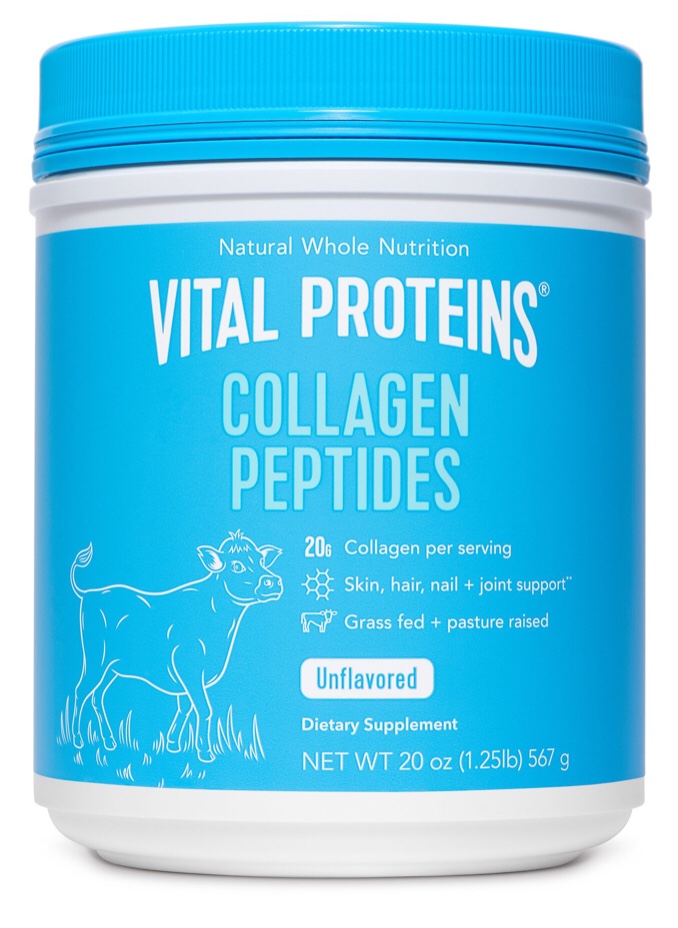
Today’s subject is collagen. Collagen is on of the most important substances in your body as it not only keeps you looking young and fresh, but literally holds you together.
Collagen is especially important for those who are doing a lot of physical training and/or are recovering from injury. I’ll lay out a specific strategy for you later in the post.
Firstly, a few pointers on buying collagen and what to be aware of;
Types
As more collagen powders pop up on the market, you might be wondering what are the differences between collagen types 1, 2, and 3, with different products repotting different ratios. This obviously begs the question which type of collagen to buy for what.
Here’s a quick summary of these different types of collagen:
Type 1 Collagen: Over 90% of the collagen in the human body is type I. Minimise fine lines and wrinkles and improves skin elasticity and hydration. Not only does it help rebuild your muscles, eyes, bones, and spine, it’s also good for strengthening your nails and helping you grow stronger, thicker hair. Type 1 collagen is most abundant in marine collagen.
Type 2 Collagen: Makes up a majority of the protein molecules in your cartilage, the connective tissue that protects your bones at the joints, in your spinal disks, and your eyes, making it a potent way to support joint health. One of the best sources is bone broth.
Type 3 Collagen: Is found in large quantities in your intestines, muscles, blood vessels, and the uterus. It’s most often used with type I collagen for gut healing and to improve skin elasticity and hydration. Bovine collagen peptides is a great source of type 1 and 3 collagen.
Does it matter?
So, this explains how we should prioritise buying our collagen? Wrong. While 28 different types of collagen do exist, which are differentiated by where in the body it’s sourced and its amino acid structure, they are all still the same protein. So in short, when you ingest collagen, you’re rebuilding all of your own collagen in the body, not just Type 1, 2 or 3, but every type.
As far as what to look for instead, the best advice is to find out where the collagen is being sourced from. If it’s China, buyer beware. Collagen sourced from China is often really cheap and just not up to the standards of higher quality collagen from Europe for example.
When purchasing a collagen product, ensure you but hydrolysed collagen as it has the best absorption in the body. Bone broth can be an excellent source but there are some dangers. The bones are where animals keep their heavy metals, so there can be a concern about led toxicity. This really highlights the need to ensure the quality of bones being used, (eg organic, grass fed, etc), or if buying store sold bone broth, a need to check for led quantities, (I know, probably easier said than done).
Timing & Quality
So there is an excellent episode on the equally excellent ‘We do Science’ podcast with Prof Kieth Baar. Kieth details that a 15-20 grams serving of collagen is the sweet spot to support healing. There is currently no evidence that this quantity should go up relative to body mass and/or training load.
Next we have the all important timing. Digest the collagen before exercise at around 40 minutes to 1 hour prior. This is the same if doing a rehab session. You ingest 40 mins to 1 hour before.
Be mindful to keep the rehabilitation sessions short by the way. The tendons/connective tissues respond to very few loads and stop responding altogether after 5/10 mins. Try and keep short loading exercises 6 hours apart from your main training sessions.
With above in mind, seek to be sport specific in your approach to the loading sessions. For example an overhead throwing athlete would perform shoulder exercises whilst a jumping athlete would perform step ups or box jumps.
Vitamin C
So here’s an absolute essential if you want to harness any healing power from collagen. Vitamin C acts as co factor (proline 4-hydroxylase) to collagen synthesis. The sooner there’s vitamin C in your day, the sooner collagen synthesis can begin.
Vitamin C is a water soluble vitamin that’s needed daily in the diet. It will be completely depleted after an overnight fast so it’s essential to get in either prior to the consumption of collagen or at the same time.
Either ensure you have a vitamin C rich meal prior to collagen supplement (such as kale or oranges) or supplement with 45-48 mg of a vitamin c supplement. Be aware the importance of taking a vitamin C supplement injury or not and aim daily for this amount to support collagen synthesis in the body if you’re not getting vitamin C rich food in your diet.
A word or warning though, vitamin C is incredibly heat sensitive and sun exposure can spoil supplemental form, so think about where you are storing it. Similarly, don’t over boil your veg as this will also kill it off!
Ok, hope you’ve found something interesting here. Please like, share and leave s comment! Till next time.

 Nutrition 4 Fighters