
Fasting for Brain Health and to Treat Concussion & Traumatic Brain Injury (TBI)

Right then! Welcome back to the What Supp Blog, the one stop shop for all things performance.

Today’s post is bought via some pretty powerful insights from Mr Dr Daniel Pompa. Dr Pomp (as I’ll affectionately refer to him as) is a pretty damn knowledgeable dude in the health and wellness space. His specialty in particular however, is the use of fasting as a wholistic tool to manage your health and wellbeing.

Ok, obviously fasting as a topic could literally fill a book, (and has, I’d recommend Dr Fung’s complete guide to fasting!),I’m going to narrow it down a little hear. Well, a lot actually. This post will give 7 pretty damn good reasons that Dr Pomp recommends fasting as a remedy to cleanse your brain and manage concussions or brain injuries. It is of note though that many of the adaptations presented completely apply to your overall health, so please don’t think this is limited purely to brain health.

Now, you may well not have had any specific concussions, but you could well play a sport which head impact is a part of the game, namely any full contact sport, or could have been in a car accident for example. Or of course, you just might want to have a brain that performs at its very best. As one of the leading lights of the science behind sleep, Mathew Walker noted, the mere act of just being awake is causing continuous minor brain damage!

It’s worth noting that when we discuss fasting here, I’m referring to anything 24 plus hours. Also, when I say fast I mean purely water fast, anything that the body has to metabolise ,(coffee, herbal tea, etc), could well short change you.

This is all simpler than it sounds with a 24 hour fast being achieved most easily from, for example, fasting from after dinner from say 7pm, to 7pm the next day. To really amp up the effects highlighted below, try and hit that 36 hour mark by seeing through the day and holding out till some time after 7am the following morning (longer the better).

If, however you really want to go deep and see some powerful results, consider a 3, 5, 7 or even 10 day fast. You will likely need a period of aductation to achieve longer fasts (reasonably) comfortably if you are eating a diet high in sugar and carbohydrates.

I won’t go into huge detail here on the science behind each point, (please check the man’s website and/or podcast), but see below the 7 reasons to implement fasting post injury;

1. Promoting autophagy . This is probably one of the best known health promoting by products of fasting. Autophagy is the body’s process of ridding bad cells/bad DNA to promote new healthy cell growth. This is especially important for your brain, and especially if you’ve suffered accumulative or acute damage.

2. There is a natural occurrence of stem cells rising. The fasting triggers them to rise up and this subsequently starts the healing process.

3. Energy diversion. It takes a certain amount of energy to process and metabolise food. Fasting triggers the body’s innate intelligence to start to use this extra energy which has been saved to start the healing process.

4. Turning off bad DNA. Yes you do have the genes you have, but what turns them on and what turns them off is all primarily down to nutritional and environmental factors. In a nutshell, fasting down regulates the bad genes and up regulate your good genes.

5. Gut health. The gut is not called your second brain for nothing. Many neurotransmitters are formed in the gut as well as it being home to all your gut microbes. Fasting can cause a change to the gut michrobiame and hence fix your gut health.

6. Brain benefits from higher ketone production. Now, similar to fasting, the benefits of ketones would fill a book. You don’t however have to start a ketogenic diet to benefit as fasting is a sure fire way to kickstart your liver into producing higher ketone levels.

7. Optimise hormone levels. This one is a lil bit of a shocker as fasting can actually elevate human growth hormone, (HGH), and norepinephrine. HGH is secreted by the brain and stimulates cell growth and reproduction. It also promotes lean tissue and helps mobilize fat, (try telling that to a muscle head down the local gym). Norepinephrine increases arousal and alertness, promotes vigilance, enhances formation and retrieval of memory, and focuses attention.

Alrighty, well there you have it, 7 good reasons to get your fast on. As already stated, all 7 have far reaching beneficial effects across the board so don’t let not having a head injury, be a good reason to not fast! Till next time.
The Genius Foods & how to remember them

Welcome back to the What Supp Blog, your one stop shop for everything to optimise performance!

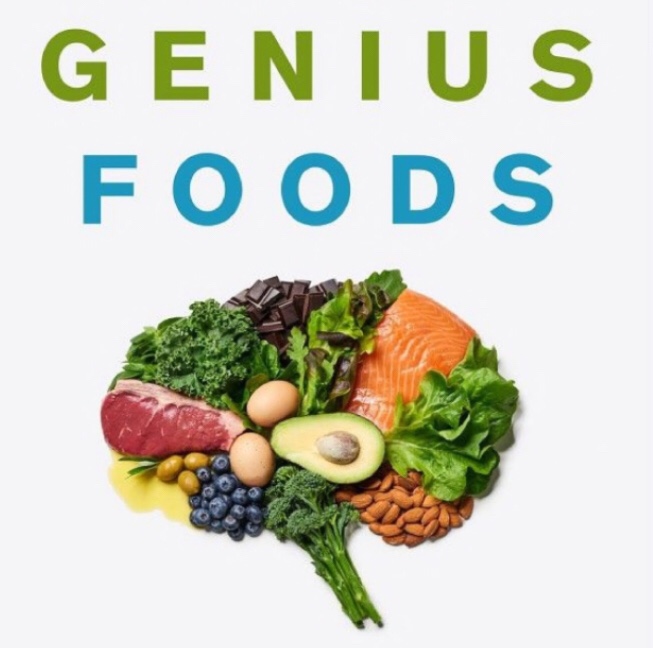
Today’s hack is two for the price of one! Firstly, I’m going to introduce you to the food list presented in Mr Max Lugavere’s New York Time’s best selling book; Genius Foods. Secondly, I’m going to show you a super simple way to remember these foods, a technique (and the actual example given) by memory extrodinare, Jim Kwick.

Max’s book is focused on what food to get into your diet to best promote your cognitive functioning whilst also highlighting what to avoid to ensure protecting it from decline. This really is a passion project for Max as his mother was sadly diagnosed with a form of neuro degenerative disease.

Although this post will present the essential food list, it won’t discuss what else can be done to avoid neuro-decline, so do your swede a fave, and treat yourself to the book.

So, first the food list;

1. Avocados

2. Blue berries

3. Broccoli

4. Extra virgin olive oil

5. Wild Salmon

6. Eggs

7. Leafy greens

8. Grass fed beef

9. Almonds coming

10. Dark chocolate

Next, how to remember. Right, so I’m gona need your imagination on this one. Jim created this imagery specifically for the 10 super brain foods. So his theory goes, the key with memory is being able to directly link the word/what your memorising, with an image. The more out of the ordinary the image is, the more likely it’ll stick.

So your going to visualise in the this order, the following body parts; Head/Nose/Mouth/Ears/Larynx/Collar/Shoulders/Fingers/Belly button/Seat (Bum).

Firstly, I want you to think of a human head, any human head. This is where we begin. This will all become clearer shortly. We will go through step by step and I want you to associate the image with food. Spend a little time on each step really visualising the image –

1. Avacados – guacamole being mixed in/on top of your your head

2. Blue berries – popping out your nose

3. Broccoli – coming in your mouth

4. Extra virgin olive oil – being used to wash your ears

5. Wild Salmon – lying around your collar

6. Eggs – placed in your larynx (adam’s apple)

7. Leafy greens – coming out your shoulders

8. Grass fed beef – for fingers or in your hands (Jim gave grass fed beef hot dogs for fingers as an example!)

9. Almonds – popping one by one out of your belly button

10. Dark chocolate and your seat, (be as creative as you will hear..)

Okay then, there you have it and hopefully you have some creative visuals going around in your head! Till next time.

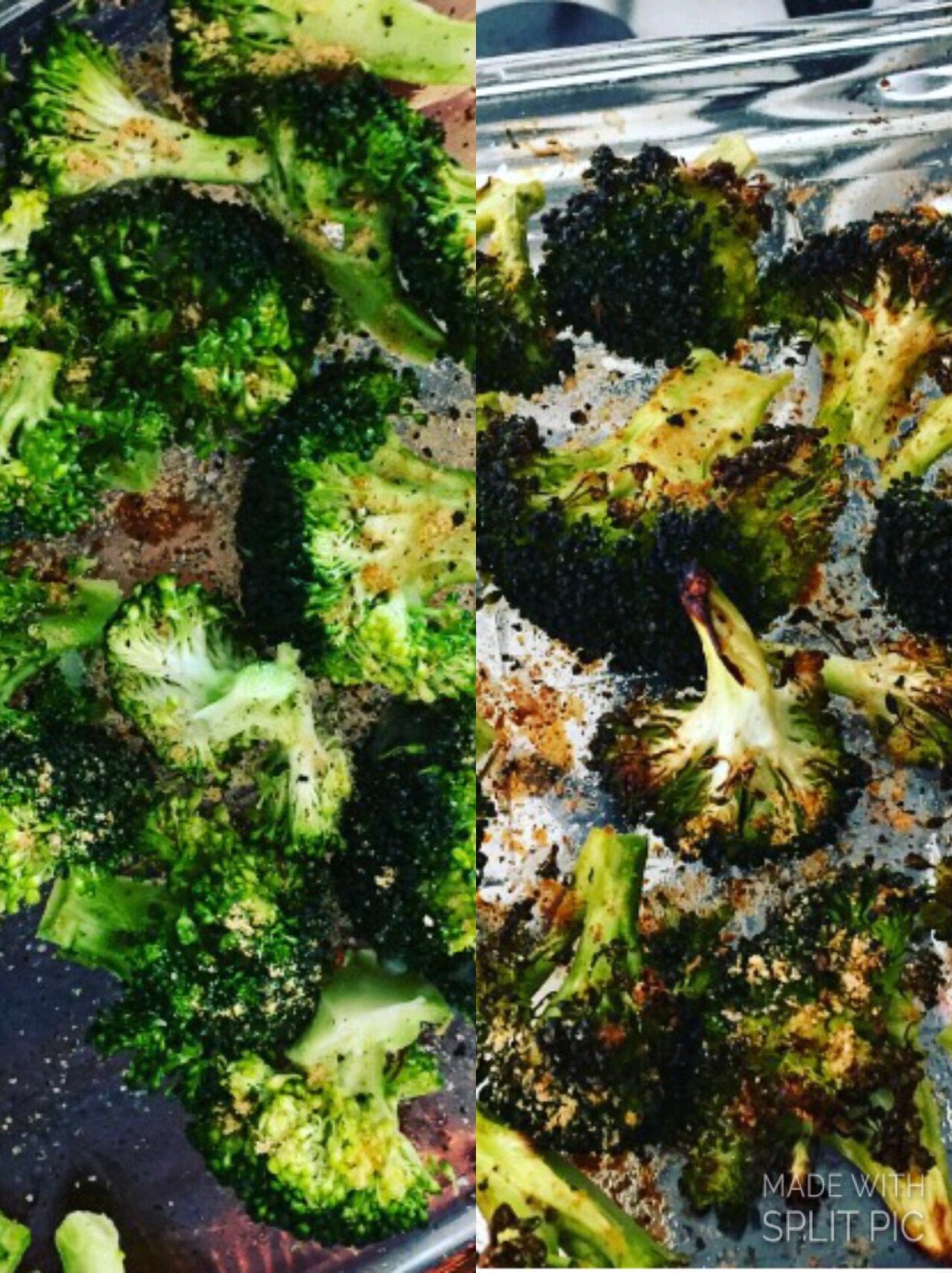
Cheap Eat Nutrition # 33 – Roasted Ginger & Coconut Broccoli Bites

Welcome back to a long overdue return to the cheap eat recipe series! These are affordable, simple recipes you can use day in, day out.

Today’s recipe is simple. It can be used as a substantial side portion of your main meal or a handy snack to take out and about.

So, you may well, and probably rightly, question the combination of broccoli and ginger. I get it. But actually not only does it give these lil nutritional nuggets a tasty twang, but it seriously adds to the health benefits you’re receiving.

Ginger has some great anti inflammatory qualities. In fact one study compared highly concentrated ginger to a placebo in 247 patients with osteoporosis of the knee. The ginger was shown to reduce pain and stiffness in the knee joints by 40% over the placebo!

Black pepper is also a nice addition, alongside the salt, for this dish. Black pepper actually helps with absorption of other nutrients, so add it wherever you can!

Right then, time for the nuts and bolts..

Ingredients

– 1 whole washed broccoli

– 1 tbsp of coconut oil

– 1 to 2 tsp of ground ginger

– salt & pepper

Method

– Chop the stem off the broccoli and cut into small florets

– Massage in the coconut oil thoroughly to broccoli florets

– Liberally sprinkle the ginger over followed by salt and pepper, (experiment a bit here with the quantity you want).

– Thoroughly tossing the broccoli, try to ensure all the pieces are well covered in the ginger, salt & pepper.

– Space out on oven tray and place in pre heated oven at 190c for 15/20 minutes, removing at 10 minutes to turn and mix the broccoli to ensure even cooking.

– Serve and enjoy!

A Whistle Stop Tour of Stoicism

Welcome back to What Supp Blog! As ever I aim to bring some of the best information for supplementing your physical and mental performances day in and day out. I’ve got something a little different for y’all today with the focus being on mindset.

In order to develop a focused and balanced mindset, it’s helpful to have outlook that promotes these qualities. This post will hopefully aid that by giving a whistle stop tour of Stoicism, the ancient Greek philosophy of, in a nutshell, learning to roll with the punches. I’ll give you a brief overview of this practical philosophy then 3 principles to live in stoic way.

The philosophy asserts that behaviour showing high moral standards equates to happiness, and judgment should be based on behaviour, rather than words. A core principle is we don’t control and cannot rely on external events, only ourselves and our responses.

Stoicism has just a few central teachings. It sets out to remind us of how unpredictable the world can be. How brief our moment of life is. How to be steadfast, and strong, and in control of yourself. And finally, that the source of our dissatisfaction lies in our impulsive dependency on our reflexive senses, rather than logic.

Stoicism has been bought back to the fore front in recent years by a few key authors such as Tim Ferris (podcast host extraordinaire), 48 laws of power supremo Robert Greene and the current go to voice of stoicism, Ryan Holiday.

Mr Ryan Holiday has released a few books that are both accessible in language and easy to digest, something some of the original stoic texts can certainly not always be. Below are three key stoic lessons that Ryan recently gave away of Dave Asprey’s Bulletproof Radio podcast;

1. Focus on what is in your control and ignore what is out of your control. This is regardless of whether it’s micro or macro issues and themes within daily living.

2. Treat obstacles you encounter as opportunities to do things you couldn’t and/or wouldn’t have done before. This in itself give you opportunity to get better at facing adversity and difficulty.

3. Make time to cultivate moments of stillness in your life, if you won’t, who will? This can be meditation or simply walking unplugged from the world. Either allowing for time to reflect and consider life’s circumstances.

Ok, thanks for reading! If you you liked, please leave a comment and like. Till next time.